
Why people leadership has become a governance imperative and what boards need to consider in Chair succession planning.
There’s a very clear trend we’ve seen at board level over the past two years; one that will have a direct impact on the success or failure of Australian boards by 2030.
This trend, which we’ve observed in the context of the more than 1000 boards we’ve worked with since 2009, involves the contemporary role of the Chair.
Boards are operating in an increasingly dynamic, complex and uncertain environment. Geopolitical instability, economic volatility, rapid technological change and shifting stakeholder expectations are converging at once, compressing the time boards have to think, decide and act.
These pressures are reshaping not just the functional aspects of governance, but the human side too – how directors work together, how boards relate to management, and how decisions get made when uncertainty is high.
Helping boards navigate this environment lands squarely with the Chair.
The key question each board must ask itself: has your board refined the Chair role for today’s environment, and have you made recruiting your next chair a priority – well before the transition is needed?
From functional leader to human system leader
Traditionally, the Chair’s role has centred on running effective meetings, building working relationships with directors and the CEO, guiding director contributions, and overseeing board composition and succession.
Those responsibilities still matter. But the environment around them has changed. Stakeholder engagement is now a central governance responsibility, requiring Chairs to engage with shareholders, members, regulators, government, the media and the broader community in ways that were once primarily the domain of management.
Artificial intelligence and faster information flows mean boards must absorb more, and respond and decide more quickly. Boards are also becoming more deliberately diverse in thinking, background and experience – which strengthens decision-making, but gives the Chair a wider range of views and working styles to reconcile in any given discussion.
Where boards actually struggle
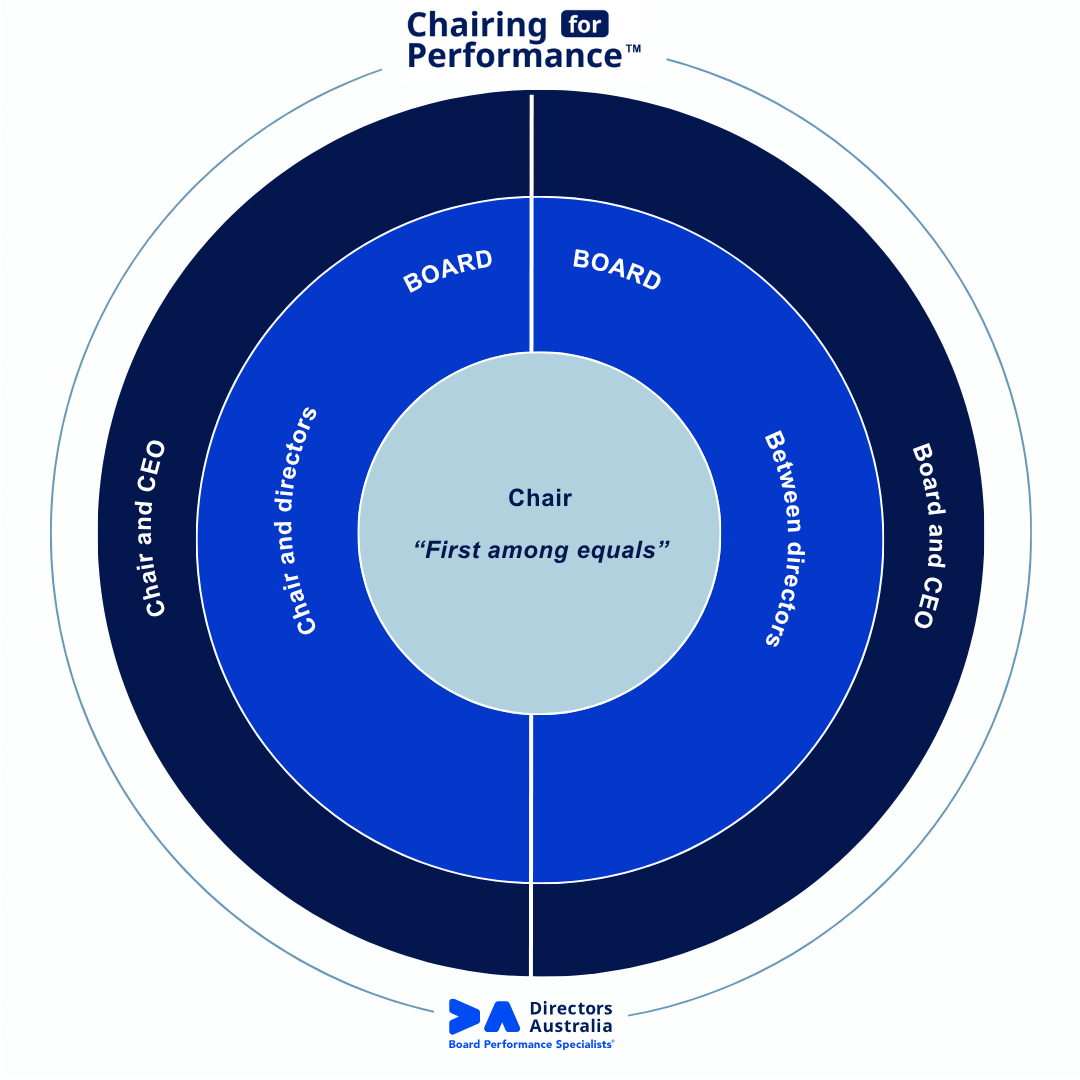
In our advisory work with a wide range of boards, the issues that surface most often aren’t technical governance failures. They’re issues of relationships, trust and dynamics – showing up in four contexts: between directors, between the Chair and directors, between the Chair and CEO, and between the board and management.
Boards rarely fail because they lack policies or frameworks. They struggle because difficult conversations are avoided, conflicting views aren’t heard or managed constructively, or the board-management relationship is strained.
As the “first among equals,” the Chair sits at the centre of leading this complex human system, playing a key role in assisting the board succeed across all four of these relationships.
“To use a sporting analogy, central to being an effective Chair today is to ‘keep up the chat’. That is, make sure the lines of communication are genuinely open both with fellow directors and especially with the CEO”.
Hon Andrew Fraser, Chair and Company Director
The Chair and CEO relationship as governance infrastructure
One of the key relationships that the Chair manages is with the company CEO.
A high-trust Chair-CEO relationship is a structural driver of board effectiveness. Trust in this context should not be confused with comfort or consensus. At its best, the relationship combines clear expectations, defined accountabilities, regular communication, a no-surprises approach and constructive challenge without personalisation.
Today’s Chair not only recognises the importance of this relationship but spends the time to nurture and maintain it.
“A contemporary Chair creates the conditions for the board and CEO to do their best work, that is holding the strategic line, enabling constructive challenge, aligning diverse perspectives and building the trust required for sound judgement in complexity”
Samantha Martin-Williams FACID, FGIA, Chair and Company Director
A broader capability and attribute set
A bigger Chair role requires more time in engaging stakeholders, supporting the CEO, managing dynamics, mentoring directors, and handling issues between meetings. This has two practical implications boards need to confront:
Chair fees need to reflect the real time commitment involved, not historical benchmarks set when the role was narrower.
Realistically, Chairs can hold fewer other board commitments than may once have been the case.
The succession question boards can’t defer
Given how significantly the Chair role has changed, the question isn’t only whether your current Chair is effective – it’s who comes next. We’ve seen many boards where this conversation hasn’t happened in time, with real consequences: a board without the right Chair risks becoming rudderless.
Boards need to redefine the Chair role for today’s environment, document it clearly, and honestly assess whether someone on the board has the skills, attributes and support of peers to step into it. If not, recruiting the next Chair becomes a priority – well before the transition is needed.
Looking ahead
We predict that by 2030, the highest-performing boards will be those with an intentional commitment to the human dimensions of governance. The Chair’s ability to build trust, foster constructive challenge, manage relationships and align diverse perspectives around a shared purpose may become the single most important determinant of board effectiveness.
The question every board should be asking today: if this is what the Chair role now requires, where does your next Chair come from?